
Insights / Research
Nature-inspired pipe fittings for lower pumping energy.
What plant branching can teach chilled water design: a study of bio-mimetic fittings, friction loss and pump energy.
Key findings
- ~33%lower friction loss across pipes and fittings in the studied circuit
- 18%lower total pump head (44 m to 36 m)
- 30 → 22 kWsmaller pump motor for the same 1,334 GPM flow
Why fittings matter
Buildings account for more than a third of global final energy use, and HVAC is typically the largest single share of a building's consumption. In chilled water systems, pumps alone can use 10–20% of HVAC energy, and every metre of pump head they must overcome is set largely by friction in the pipe network.
Straight pipe is only part of that friction. Fittings (tees, elbows and valves) can account for 20–30% of the pressure loss in a closed-loop system. Yet the standard way of connecting a branch to a header has barely changed: a 90-degree tee, followed by 90-degree elbows.
What plants already know
Plants move water from roots to leaves through a pipe network refined over millions of years. Inefficient, high-resistance designs have been selected out. One recurring feature is that branches leave the stem at an acute angle rather than a right angle, so flow changes direction gradually.
The research asked a practical question: can the same principle be applied with fittings that are already available on the market? Two direct substitutes fit the pattern:
- a lateral “wye” in place of a standard reducing tee
- 45-degree elbows in place of 90-degree elbows
How it was assessed
The study combined three steps:
- Fitting-level comparison using equivalent pipe lengths from the Carrier design handbook, at a constant friction rate of 2 ft per 100 ft of pipe.
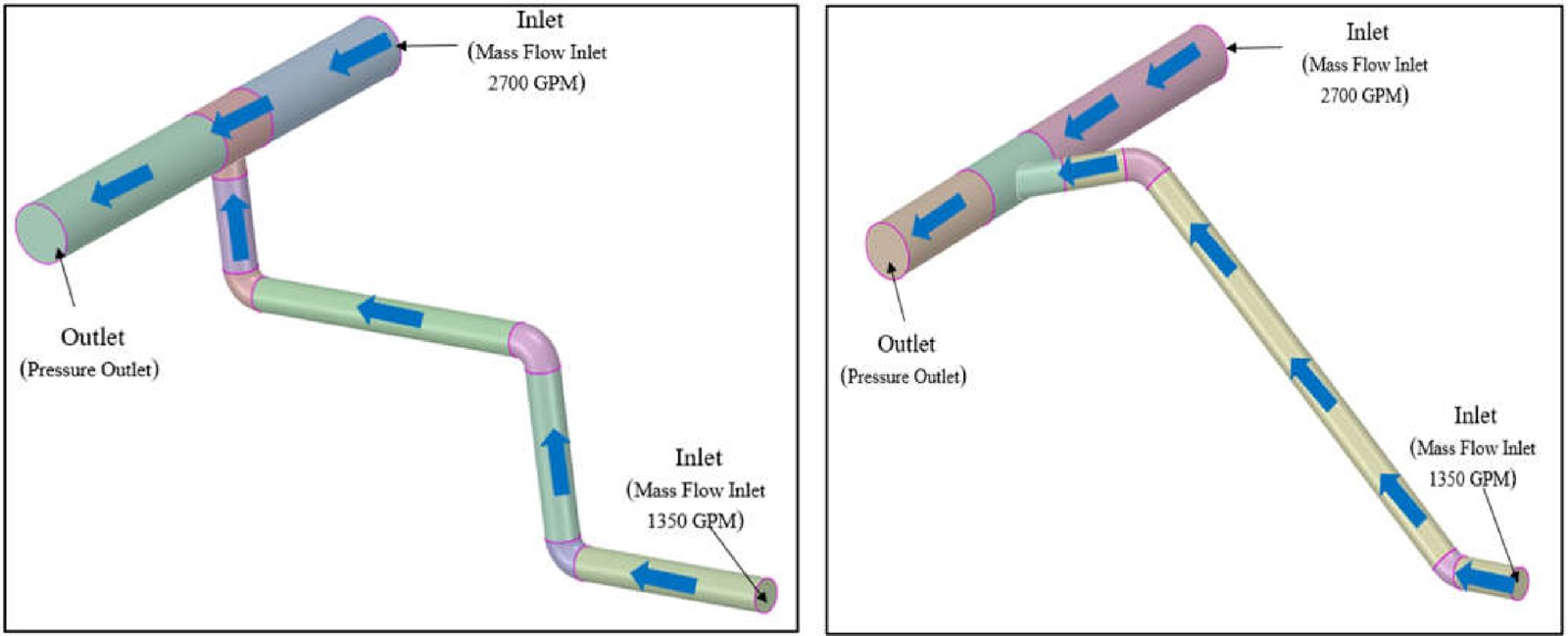
- CFD simulation in ANSYS Fluent of a 250 mm branch joining a 450 mm header (1,350 GPM into 2,700 GPM), with traditional and bio-mimetic fittings.
- System-level calculation for the furthest chilled water circuit of a 40-storey office building, using the Hazen-Williams method, followed by pump selection with a manufacturer's sizing tool.
Fitting by fitting
| Fitting | Friction loss (Pa) | Reduction |
|---|---|---|
| Standard reducing tee | 5,081 | ~15% (up to 20% at smaller sizes) |
| Lateral wye | 4,316 | |
| 90-degree long-radius elbow | 1,734 | ~21% (up to 30% at smaller sizes) |
| 45-degree elbow | 1,375 |
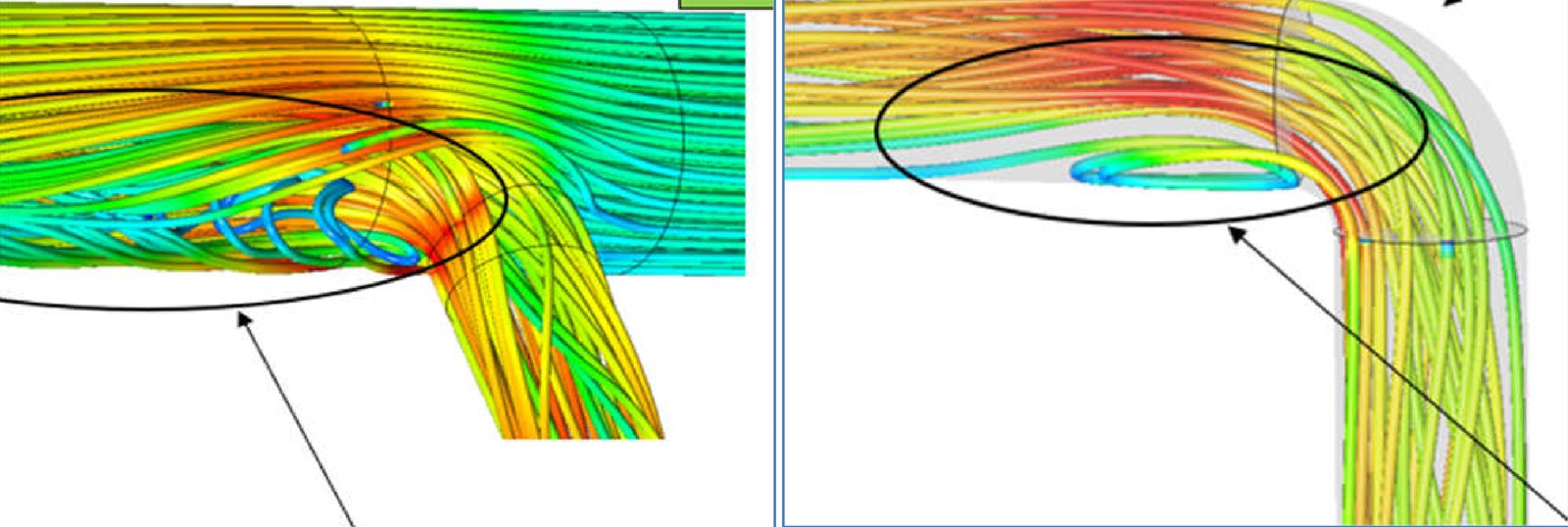
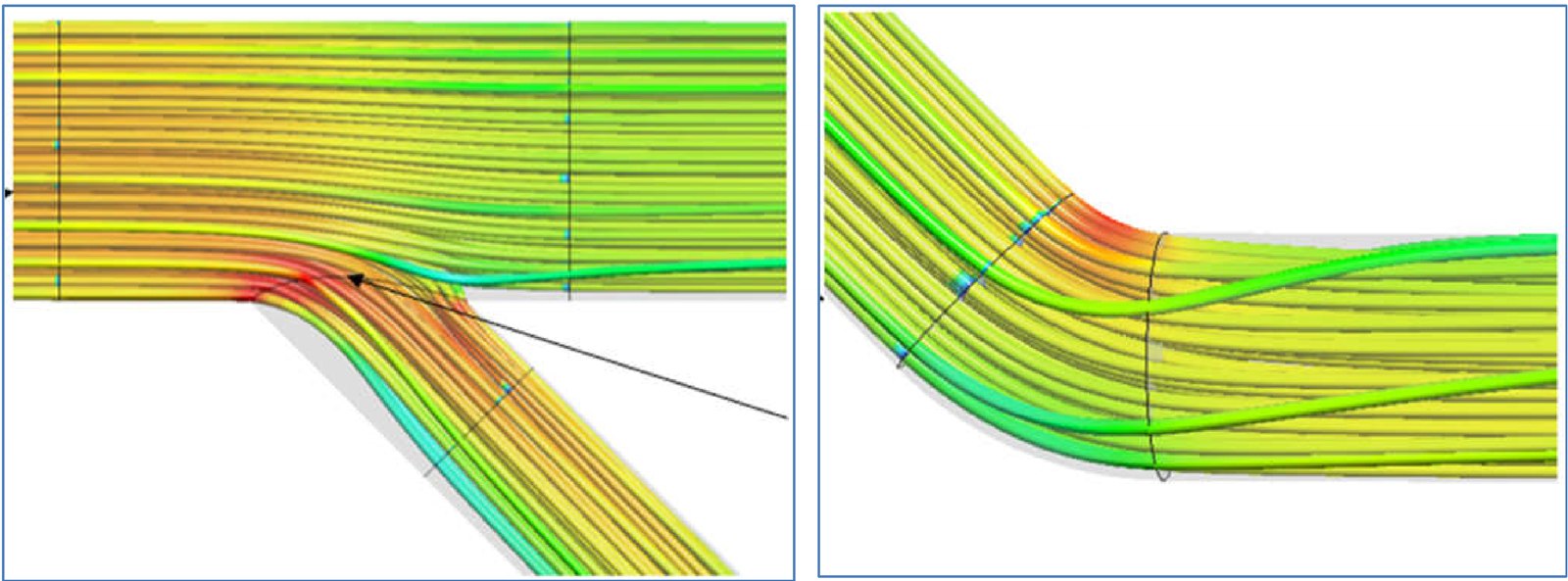
The CFD streamlines told the same story. With a standard tee, branch flow enters the header abruptly, creating a high-velocity zone and turbulence downstream. With a lateral wye, the branch merges gradually, with smaller velocity spikes. The 45-degree elbow showed a smoother change of direction and less recirculation than the 90-degree bend.
Across a whole circuit
| Traditional | Bio-mimetic | |
|---|---|---|
| Pressure drop, pipes and fittings | 23.6 m | 15.7 m |
| Total pump head | 44.0 m | 36.0 m |
| Pump flow | 1,334 GPM | 1,334 GPM |
| Selected motor rating | 30 kW | 22 kW |
Other components in the circuit (chiller evaporator, heat exchanger, valves, meters) were unchanged, so the whole difference comes from the pipework. The smaller head allowed a pump with a motor rating about 27% lower. Over a 15-year life with two duty pumps and one standby, the manufacturer's lifecycle estimate for the smaller pump set came to about 43% less than for the larger one (INR 74.7 lakh against INR 132 lakh).
The trade-off
Acute-angle connections take a little more space than right-angle ones, particularly in plant rooms. That needs early coordination with the architect and structural team, which is exactly where it is cheapest to solve. The fittings themselves are standard catalogue items; nothing bespoke is required.
What this means in practice
The lesson is not a single product but a habit: question the default fitting. On pumped hydronic systems, choosing lower-resistance fittings at the design stage reduces pump head, pump size and energy use for the life of the building, at little or no extra capital cost. It is the kind of engineering decision that is easy to make on the drawing and very hard to change once installed.
Want to discuss energy-efficient chilled water design for your project? Talk to us.